
This is information shown on Wikipedia – the records of St Firmin’s Church show that Edward Harwood son of William Harwood was baptized on September 2nd 1576
Information from Wikipedia
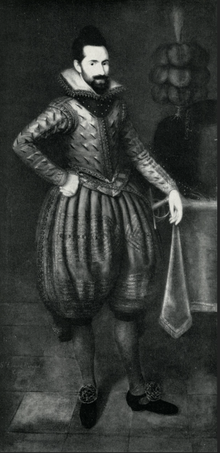
Portrait of Sir Edward Harwood by the workshop of Jan van Ravesteyn
He was born about 1586, in Thurlby a member of an old Lincolnshire family[1], and had an extended military career, entering Dutch service at age 13, gaining a company after combat at the Siege of Ostend. He took part in the Sluis campaign in 1604 under Horace Vere and was ranked captain by 1606 after the siege of Rheinberg.[2] Around this time he attracted the favour of Prince Maurice of Nassau, captain-general of the United Provinces and future Prince of Orange, becoming one of his personal servants in the privy chamber.[3] At some point in the years between his promotion to the position of captain and the Cleves-Jülich campaign of 1614 he was knighted.[4] He became colonel of an English regiment in the Netherlands in 1622/3, by purchase from Viscount L’Isle;[5] and was then one of the four standing colonels in the Low Countries. He was shot and mortally wounded at the Battle of La Felt during the siege of Maastricht on 11th August 1632, pierced through by three successive bullets.[6] In 1636 one of his officers, Captain Nicholas Byron, erected a monument to his memory in the Hague where he was buried on the instructions of Prince Maurice.[7] His brother George Harwood belonged to the Feoffees for Impropriations.[8]
Harwood was known as a lay supporter of Puritanism. In Dutch affairs leading up to the Synod of Dort, and at that time lieutenant-colonel in Viscount L’Isle’s regiment, he was briefing George Abbot.[9] He intervened in 1622 to secure the appointment of William Ames at the University of Franeker;[10] and he also supported John Burges.[11] He was a significant international connection for Puritans.[12]
Harwood signed the Second Virginia Charter of 1609.[13] He was also involved in the Somers Isles Company, and was a charter member of the Providence Island Company.[14]
Death and legacy
Harwood died in 1632 during the Siege of Maastrict.[15] In 1636, friends of Sir Edward Harwood had a memorial plaque erected in the Cloister Church in The Hague, where he was buried.[16]
Works
In 1642, his brother George Harwood, a merchant of London, published The Advice of Sir E. Harwood, written by King Charles his Command, upon occasion of the French King’s preparation, and presented in his life time by his owne hand, to his Majestie: … also a Relation of his life and death, by Hugh Peters, &c., London. It was reprinted in Harleian Miscellany, ed. Park.[6] Peters met Harwood around 1630, and may have acted as his chaplain.[17]
References
- The Visitation of London: Anno Domini 1633, 1634, and 1635. Made by Sr. Henry St. George, Kt., Richmond Herald, and Deputy and Marshal to Sr. Richard St. George, Kt., Clarencieux King of Armes, pg 349
- Mary Arshagouni Papazian (2003). John Donne and the Protestant Reformation: New Perspectives. Wayne State University Press. pp. 171–2. ISBN 978-0-8143-3012-8. Retrieved 21 May 2012.
- http://www.falakros.net/bourne/portrait/harwoodedward.htm
- http://www.falakros.net/bourne/portrait/harwoodedward.htm
- Charles Dalton, Life and Times of General Sir Edward Cecil, Viscount Wimbledon vol. 2 (1885), pp. 15–6; archive.org.
- Goodwin 1891.
- http://www.falakros.net/bourne/portrait/harwoodedward.htm
- Nicholas Tyacke (2001). Aspects of English Protestantism, C. 1530-1700. Manchester University Press. p. 121. ISBN 978-0-7190-5392-4. Retrieved 21 May 2012.
- Anthony Milton; Church of England. Record Society (2005). The British Delegation And the Synod of Dort (1618-1619). Boydell Press. p. 22. ISBN 978-1-84383-157-0. Retrieved 21 May 2012.
- Francis J. Bremer (9 June 1994). Congregational Communion: Clerical Friendship in the Anglo-American Puritan Community, 1610-1692. UPNE. p. 94. ISBN 978-1-55553-186-7. Retrieved 21 May 2012.
- David Worthington (25 January 2010). British and Irish Emigrants and Exiles in Europe, 1603-1688. BRILL. p. 243. ISBN 978-90-04-18008-6. Retrieved 21 May 2012.
- L. J. Reeve (30 October 2003). Charles I and the Road to Personal Rule. Cambridge University Press. p. 215. ISBN 978-0-521-52133-8. Retrieved 21 May 2012.
- William Stith (1747). The history of the first discovery and settlement of Virginia. Reprint Co. p. 348. ISBN 9780871520265. Retrieved 21 May 2012.
- Karen Kupperman, Providence Island 1630 – 1641: The Other Puritan Colony, Cambridge University Press, (1995), p. 358.
- Jim Harwood, The Harwood Family, Including Allied Families (Norfolk, 1998) p. 15

 Thurlby Village together with Northorpe